

Cobra Drive HD Dash 2316D review: Dual cameras, neat features, poor night video - johnsondech1948
At a Glance
Expert's Military rating
Pros
- Inexpensive for a dual-camera system
- Easy to use
- Meshes with and plays Cobra iRadar app alerts
Cons
- No HDR and lax nighttime telecasting
- Cluttered cabling system
Our Verdict
Two years on from the 895HD, the Tug HD DASH 2316D offers only minor improvements, and no concern the video, which is weak past today's ever-uphill standards. The iRadar app is useful, but GPS is only an option. To our mind, the cheaper 895HD (if you can determine it) is still the better deal.
I was anxious to try the $240 Drive HD Style 2316D dual-camera system and construe with what Cobra brings to the table these years. We gave the last dual-camera Cobra solution I reviewed, the CDR895D Drive HD, an Editor program's Quality, largely because of ease of use and baritone price. That system's Nox video has since been eclipsed in quality by many cameras, symmetric entry-storey models. I expected and hoped the Daunt 2316D had evolved with the multiplication.
Tall story short: In damage of usability, the Dash 2316D is on spot. On that point are numerous nice-to-have new features iRadar (Cobra's information armed service) dealings alerts, and driver assist. But when it comes to video quality, the Dash 2316D has not evolved, and there are a few other features I'm surprised Cobra hasn't improved.
Greenbac: This survey is part of our smash Cam roundup. Go thither for details about competing products and how we tested them.
Design and glasses
The Dah 2316D's front camera, with a 160-degree field of view, is a small, squarish affair with a two-inch LCD display. It's easy to hide behind your windshield mirror, which gives you a very good alibi in states that outlaw vision-obstructing devices on your windshield. You never screw when a main road patrol officer will be looking for for an excuse to ticket you.
The camera offers four ports: a 3.5mm jack for the elective $50 GPS; a slot for the SD card; HDMI output for direct playback connected your TV; and a micro USB port for power and connecting to a computer.
The camera is controlled and configured using four buttons on the bottom that depart in function, illustrated by icons onscreen direct above the buttons. During formula use the buttons invoke: pause recording, claim shot, mute microphone, and split/rear/forward view. Press the pause release, and you enter the settings mode.
At the top is a blue button (silver for non-Bluetooth models) that starts emergency brake recordings (mechanically overwrite-protected), and a "power"/display-off button.
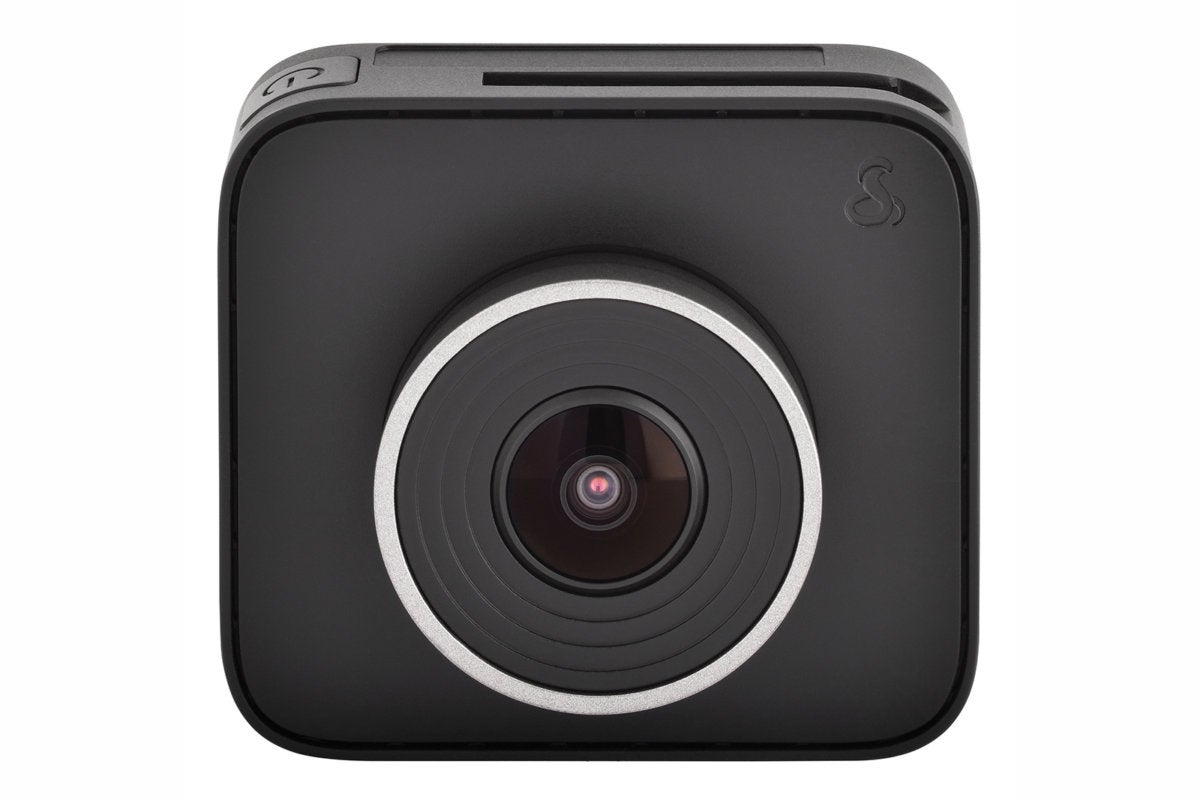 Cobra
Cobra The Drive HD DASH 2316D front tv camera is small enough to hide behind most seat-persuasion mirrors. That's handy if someone claims it was blocking your view in a lawsuit.
The 130-degree rear camera is a tube-shaped structure design, and captures TV in 720p rather than the 1080p that the front defaults to. That's to a higher degree adequate for legal purposes.
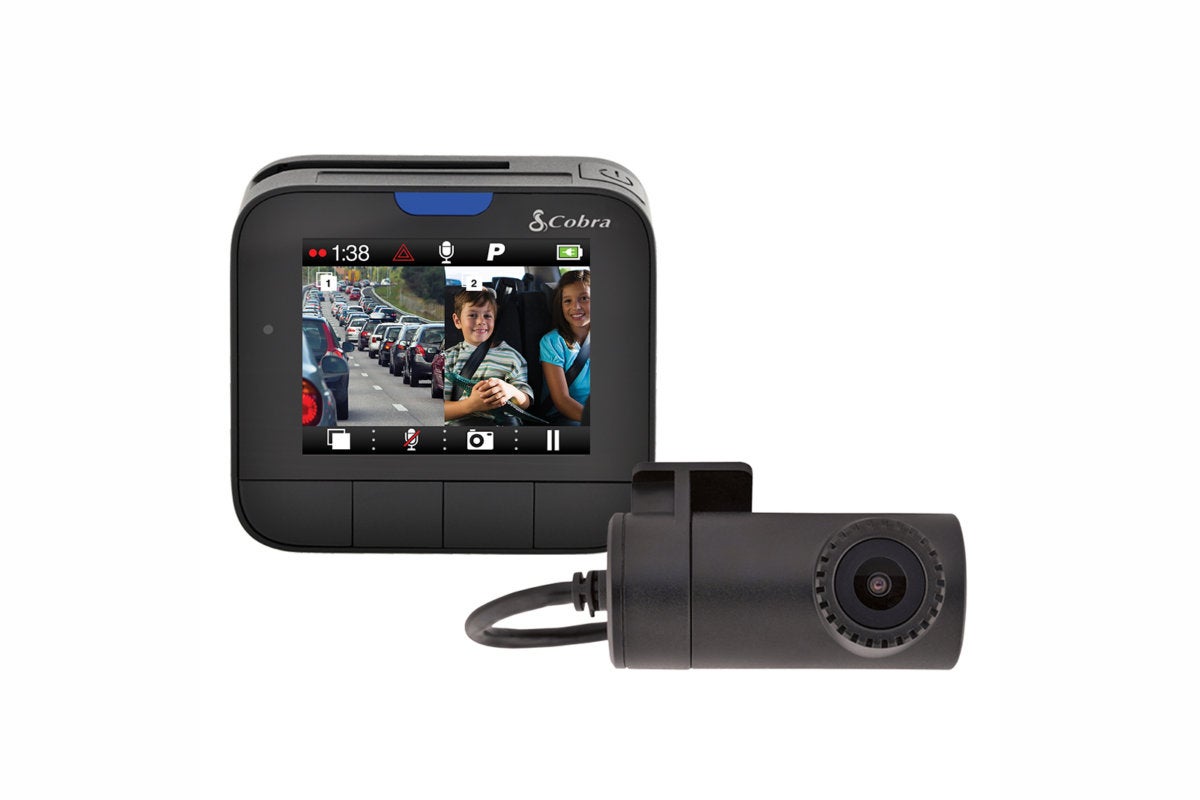 Cobra
Cobra The display of the front photographic camera and the rear window camera are shown here. Note that the immature bit of cable television service shown is a bit misleading: Individual cables are required to allow for all the connections between the two units.
The cabling for the Dash 2316D is complex, to say the least. Instead of two inputs along the front television camera for power and the rear camera, the affair involves a Y-adapter and three other cables. With the CDR-895D, I thought IT a clever way to morph a front tv camera that was meant to pilot solo into one that plays nice with a second unit. Two years on, it seems more like a kludge that should've been redesigned by at present.
The front camera captures in four resolutions: 1296p/30 frames per arcsecond, 1080/30fps (the default), 720/60fps, and 720p/30fps. High-resolution selections will, of course, use more storage blank space. There's also a parking mode that leave cover transcription for 5 surgery 10 minutes after power is removed. Driver-assistance features, or what I call bad-driver features, include lane departure and collision warnings for those with snub attention spans. Monition: If that's something you spirit you deman—take the coach.
The Scare off 2316D also sports Bluetooth for communications with Cobra's iRadar iOS/Android app. I wish I could study that it worked well, offloading alerts to the camera and providing the GPS info that we always recommend. But for some reason, after one initial connect, I was ne'er able to repeat the experience. I reliable ternion different phones, and while the Dash 2316D would appear as "Drive HD," it only wouldn't shake hands beyond that. Cobra says it's on the job on a fix for Android. Merely this does point forbidden the television camera's reliance on your phone for GPS. Consider the $50 module.
Both the front and rear cameras inhere in the windows using semi-permanent hard tape. The front camera jump on is fully adjustable and will tolerate misalignment, but the rear one is more stubborn. Tip over: Use a ruler and level to mark the climb point primary.
Performance
A you give the sack see below, the Dash 2316D's solar day captures are quite good—bright, and with nice detail. I was told HDR was in play, and the colors seem a bit more sodden than with the CDR-895D, but it's not quite an Eastern Samoa patent as with some other cameras.The bit depth of the Dash 2316D's captures was only 8 bits. HDR is generally related with 10-bit color, though IT's also accustomed indicate a greater range of luminance.
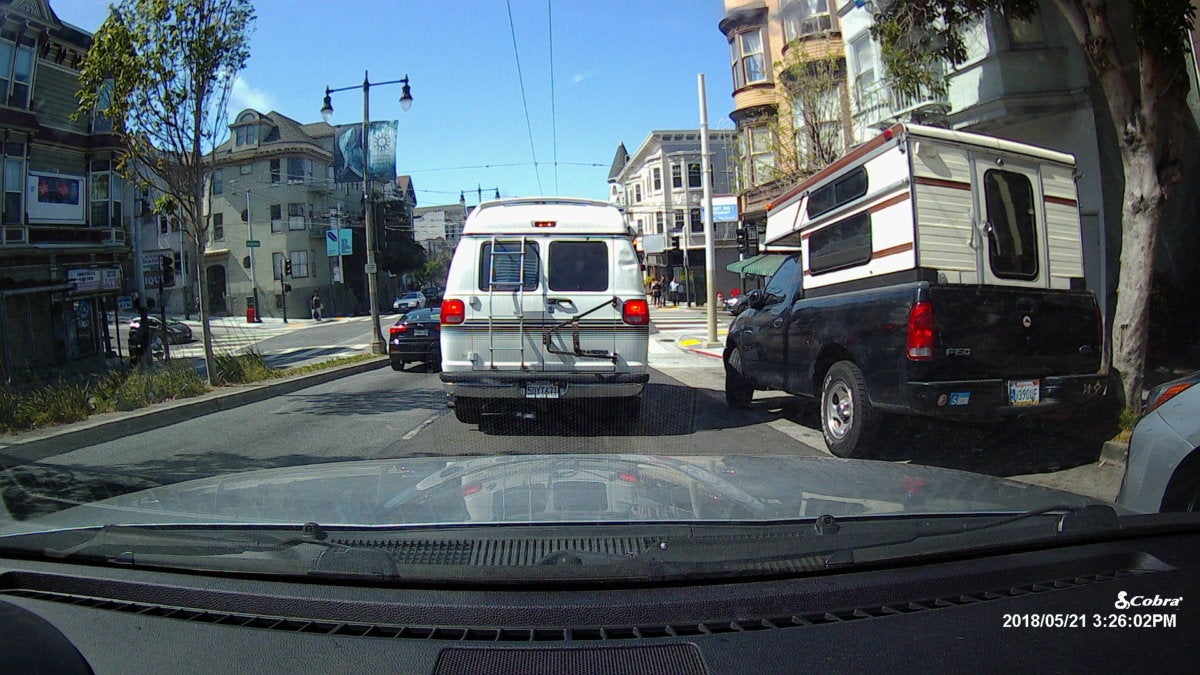 IDG
IDG The daytime video recording captured from the Dash 2316D's cameras (front is shown) is quite an good. HDR isn't arsenic saturated as with some cameras we've seen..
Things went wrong for the Scare away 2316D at night. Nocturnal video from the front camera was acceptable in substantially-lit city situations, but way too dark and lacking in detail when we pulled onto a English street (shown down the stairs). The better cameras outer there improve greatly connected what the human centre can go out. Therein case, the scene was actually much brighter than information technology appears.
The only thing positive I can say about the Dash 2316D's night captures it is that thither was exclusively a moderate amount of headlight flare. The vertical blaze up shown infra is largely due to my running out of windshield washer liquid. Sorry approximately that Cobra.
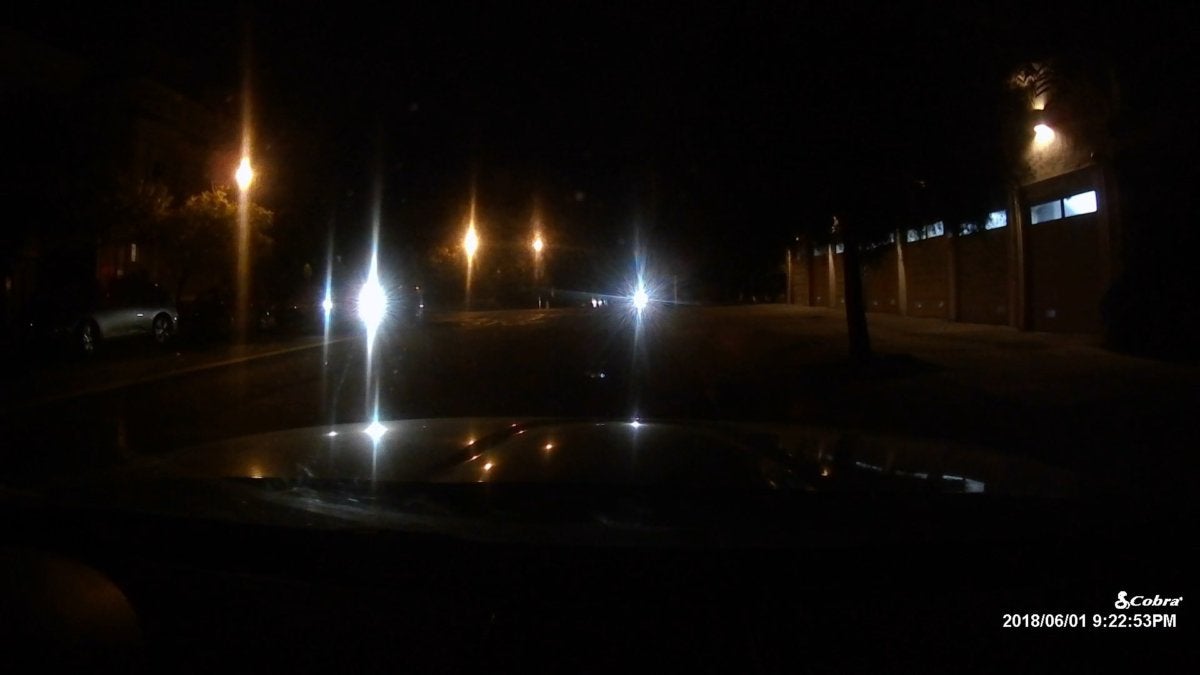 IDG
IDG The nighttime video from the front video is inadequate in contingent and would be near useless in a court of law. Please Federal Reserve note that the vertical flared is largely the fault of a poorly cleaned windshield. My bad.
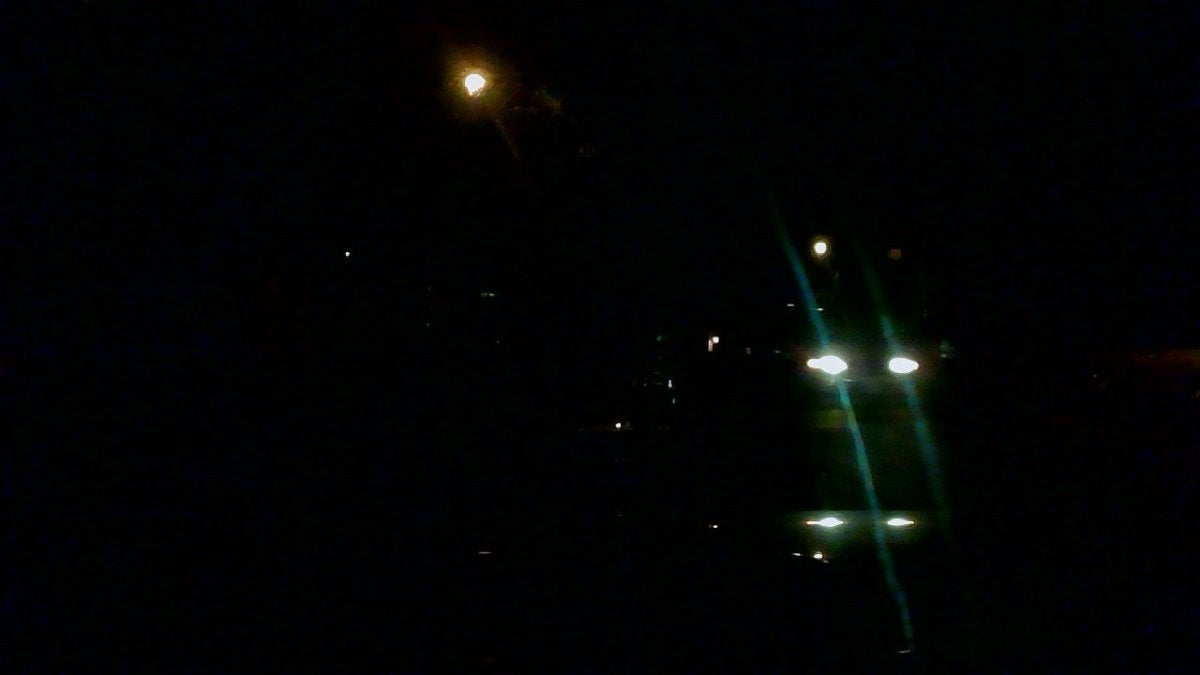
The rear camera video was even worse at Nox. Put up-processing (upping the brightness and contrast) didn't help with either camera, equally I've seen with close to unusual cameras. Put differently, the detail just didn't make it to telecasting, whether information technology's the sensors Beaver State the intramural processing.
 IDG
IDG The 2316D's rear camera captures show barely some detail in the least, plane with headlights lighting upward the area.
Two years past we might've given the Dash 2316D's night captures a pass, as murkiness was largely the norm. That was then, this is now. Other competing cameras leverage Sony's STARVIS sensors, and the entire industry upping its game. Hopefully, it's not simply a failing of the Ominivision sensors (advanced: OV4369, back: OV9712), just kinda processing issues that can be fixed with a firmware update.
As far as operating conditions are concerned, the cameras are rated from 14 to 140 degrees Fahrenheit. They ran cooler than average in my hands-on, flatbottomed with the front photographic camera's display running full time. The G-sensing element worked fine at the default setting, saving video when I hit a really large pothole connected purpose to test it, merely otherwise avoiding faithlessly positives.
Conclusion
The improvements Cobra has ready-made with the Drive in HD Dash 2316D are for certain welcome. The integration with the iRadar app is nicely finished, and downloading the GPS via Bluetooth could eliminate the demand for the $50 GPS unit if you're a earphone-centric user. I'd rather see the GPS on board. Overall, serviceableness and design are top-notch.
Just all that way nothing if the video isn't up to snuff, and the Dash 2316D's night video most decidedly isn't. Whatever the offspring, as of now I can't recommend the Dash 2316D scheme for period use, only when our friendly cowardly nanus prima is come out and about.
Source: https://www.pcworld.com/article/402009/cobra-drive-hd-dash-2316d-dash-cam-review.html
Posted by: johnsondech1948.blogspot.com
0 Response to "Cobra Drive HD Dash 2316D review: Dual cameras, neat features, poor night video - johnsondech1948"
Post a Comment